
What Are the Functions of Different Types of Reactors?


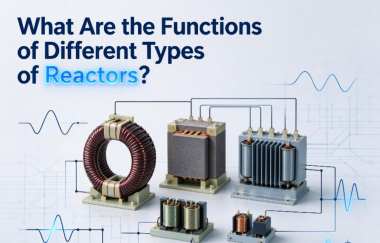
In the electronic components industry, reactors are inductive components commonly used in power systems and power electronic equipment. They are widely applied in variable frequency drives (VFDs), industrial power supplies, reactive power compensation devices, and harmonic mitigation systems. Different types of reactors vary in their circuit connections, installation locations, and design objectives. Their primary functions include limiting current, suppressing harmonics, improving voltage stability, and protecting electrical equipment. Understanding the functions of different reactors helps engineers select suitable components for specific circuit requirements and improve system stability and reliability.
Catalog
III. Functions of Different Types of Reactors
I. What Is a Reactor?
A reactor is an electrical component that primarily operates through inductance. It typically consists of a coil, and some designs also incorporate a magnetic core. Through electromagnetic induction, a reactor opposes changes in current, making it useful for limiting sudden current variations, suppressing current components at specific frequencies, and improving the operating conditions of power systems.
Depending on their circuit connections and application locations, common types include series reactors, shunt reactors, DC reactors, input reactors, and output reactors. These classifications are not entirely independent. For example, input and output reactors are named according to their installation locations in a variable frequency drive system, whereas series and shunt reactors are classified according to how they connect to a circuit.
II. How Does a Reactor Work?
A reactor relies on the magnetic field generated by its coil to oppose changes in current. When the current changes, the magnetic field inside the coil also changes, inducing an electromotive force that opposes rapid current variations. This characteristic enables the reactor to limit current surges, slow changes in current, and present different levels of impedance to AC components at different frequencies.
In AC circuits, reactors can work with capacitors, resistors, and other components to suppress harmonics, perform filtering, and regulate reactive power. In variable frequency drive systems, reactors can also reduce electrical disturbances on the power supply side or motor side, improving operating conditions. Their actual performance depends on inductance, rated current, operating frequency, and the circuit configuration.
III. Functions of Different Types of Reactors
1. Functions of Shunt Reactors
Shunt reactors are connected in parallel with power system circuits. Their primary function is to absorb capacitive reactive power generated by transmission lines or cables, helping control voltage rises. In long-distance transmission lines and high-voltage cable systems, line capacitance can cause voltage increases under light-load or no-load conditions. Shunt reactors help improve voltage distribution and maintain system voltage within an appropriate range.
Shunt reactors can also support reactive power management in power systems. However, their compensation effects depend on the operating conditions of the system and the reactor's capacity. They should not be considered a universal voltage regulation solution for every application.
2. Functions of Series Reactors
Series reactors are connected in series with a circuit. Their primary functions include limiting short-circuit current, suppressing harmonics, and reducing inrush current when capacitor banks are energized. In reactive power compensation systems, series reactors are often used with capacitor banks to reduce harmonic amplification and resonance risks, improving the operational safety of the capacitors.
The design objectives of series reactors vary by application. Current-limiting reactors are primarily designed to restrict fault currents, while detuning reactors used with capacitor banks help control harmonic interactions and prevent undesirable resonance.
3. Functions of DC Reactors
DC reactors are commonly installed in the DC bus circuit of a variable frequency drive. Their main functions are to smooth DC current, reduce current ripple, and suppress certain harmonic components. They can improve the current waveform in the rectifier stage, reduce DC-side current fluctuations, and improve the input power factor of a drive under certain operating conditions.
DC reactors can also reduce the effects of current surges on components connected to the DC bus, helping the drive operate more reliably. Their actual performance depends on the rectifier topology, load characteristics, and reactor parameters.
4. Functions of Input Reactors
Input reactors are installed on the power supply side of variable frequency drives and other power electronic equipment. Their main functions include limiting current surges, reducing grid-side harmonic currents, and mitigating the effects of certain power supply disturbances and voltage fluctuations on equipment.
In variable frequency drive applications, input reactors can also reduce current distortion caused by the rectifier stage and improve the input current waveform to some extent. However, input reactors cannot replace dedicated surge protection devices, electromagnetic interference (EMI) filters, or other power protection components. Their protective capabilities depend on their design and application conditions.
5. Functions of Output Reactors
Output reactors are typically installed between a variable frequency drive and a motor. Their primary functions include slowing current changes, suppressing high-frequency components, and reducing the effects of certain voltage spikes at the motor terminals. In systems with long motor cables, output reactors can improve electrical operating conditions on the motor side and help mitigate high-frequency currents and certain electromagnetic disturbances.
However, an output reactor should not be considered equivalent to a dedicated sine-wave filter or a voltage rise-time filter. If an application has strict requirements for motor terminal voltage waveforms, insulation stress, or cable length, the appropriate filtering solution should be selected according to the drive's output characteristics and the motor specifications.
IV. Conclusion
Different types of reactors share the fundamental operating principle of inductance, but their specific functions depend on their installation locations, circuit connections, and application requirements. Shunt reactors primarily absorb capacitive reactive power and help control voltage, while series reactors are mainly used for current limiting and harmonic suppression. DC reactors smooth DC current, whereas input and output reactors improve electrical conditions on the power supply side and motor side, respectively.
When selecting a reactor, engineers should consider rated current, inductance, operating voltage, harmonic characteristics, installation environment, and equipment requirements. Proper reactor selection and configuration can help reduce electrical disturbances, improve system stability, and enhance the reliability of power electronic equipment.


